Research platform · Case study
AI-Assisted TDD for Robotics Learning
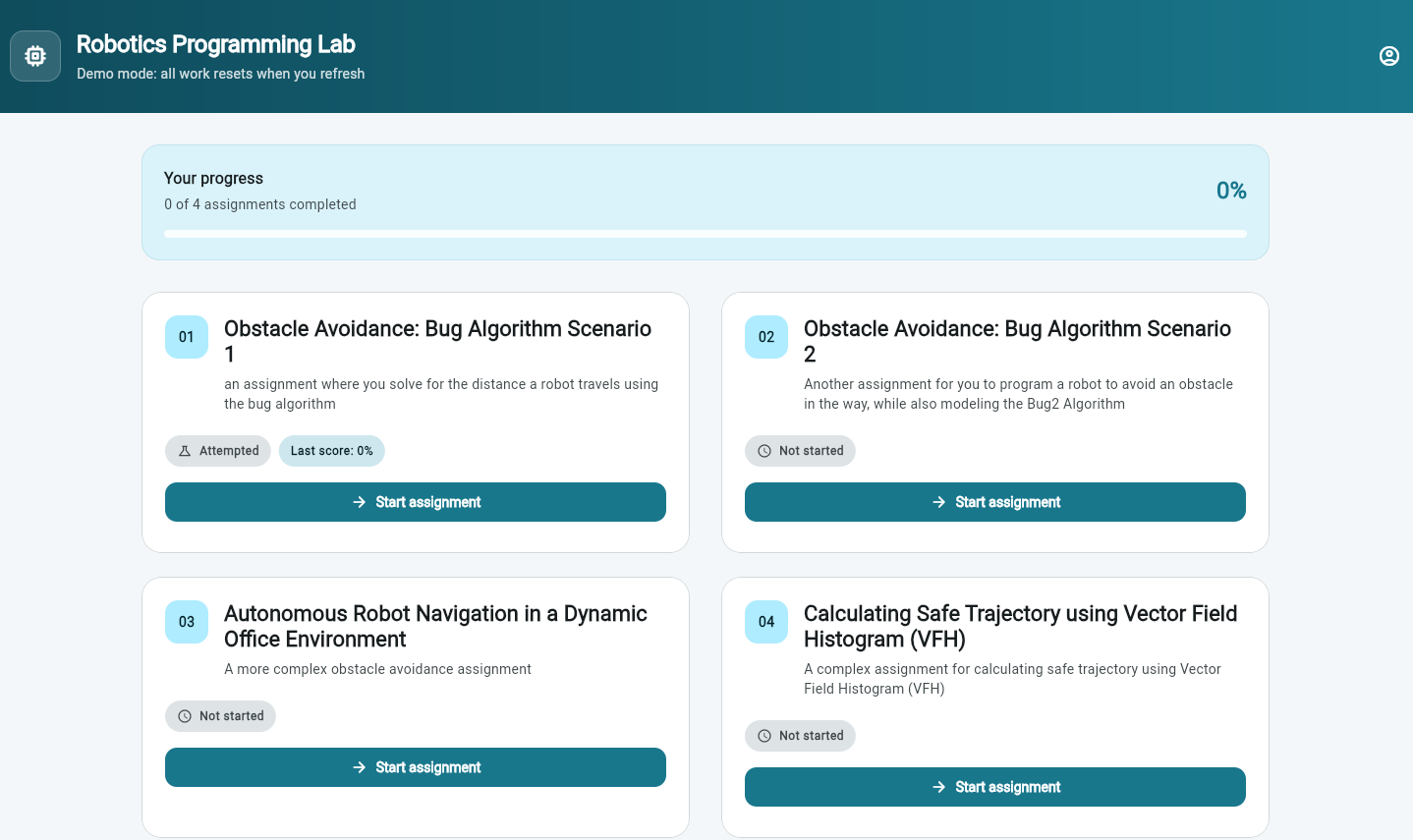
A learning environment that brings browser-based programming, automated evaluation, behavioral telemetry, ROS2/Gazebo simulation, and guardrailed AI tutoring into one workflow.
 Research platform
Project overview
Robotics Learning Platform
Built an NSF-funded learning platform that joins browser-based programming, automated evaluation, behavioral telemetry, robotics simulation, and guardrailed AI tutoring in one workflow.
Ph.D. research + Robotics Learning Platform
A complete learning cycle, from guided content to measurable improvement.
Behavioral telemetry connects student attempts, test outcomes, help-seeking, and revisions to the study of accuracy, efficiency, recovery, robustness, and learner experience.
- Context
- NSF-funded research, University of Nevada, Reno
- Role
- Graduate Research Assistant
- Timeline
- August 2022 to present
- Users
- 100+ students
- Status
- Platform developed, experimental evaluation in progress
The problem
Help that supports learning instead of bypassing it
Robotics learners need timely, contextual help while writing code, interpreting test failures, running simulations, and debugging robot behavior. Traditional lab support does not always scale, while unrestricted generative-AI answers can skip the reasoning students need to practice.
The system
One connected learning loop
ROS2 and Gazebo simulation connect evaluation results to robot behavior. Attempts, failures, and recovery signals provide context for feedback while guardrails keep final solutions hidden.
What I built
From evaluation infrastructure to research evidence
Python-based automated evaluation using unit tests, hidden checks, pattern recognition, and real-time failure analysis.
Behavioral telemetry for pass rates, attempts, recovery time, edit-run cycles, stuck states, and learning outcomes.
ROS2 and Gazebo workflows for simulation-supported robotics exercises.
LLM pipelines that analyze code and learning context while guiding students without exposing final solutions.
Personalized analytics and recommendation workflows for learners, instructors, and research evaluation.
Demonstrations, technical documentation, peer-reviewed papers, and stakeholder communication.
Evaluation
Measured across system and learning outcomes
Measures: accuracy, efficiency, recovery, robustness, and learner experience.
The research uses hypothesis-driven evaluation. Platform development is complete and experimental evaluation is in progress, so preliminary observations are not presented as final conclusions.
Technology
Evidence